Earlier this year [2019], I was working on a project surveying for rare plants and natural communities in the Big South Fork of Kentucky. Hidden in the biologically diverse region of the Cumberland Plateau, we share this region with Tennessee, where headwater streams flow north into Kentucky and create river scour communities along the Big South Fork of the Cumberland River. The Big South Fork is by far one of my favorite places on Earth. The diversity of species, both plants and animals, even undescribed taxon, is astounding. And the river scour communities within this region contain more globally rare plants than anywhere else in Kentucky! This species diversity is only compounded by the complexity of the riparian communities from emergent marshes, outcrops, grasslands, shrublands and woodlands that are maintained by the wild river scour. It’s one of the few places still left in Kentucky where pre-settlement natural conditions still exist, it’s as if you are seeing a landscape that was seen by Native Americans, a true wilderness. And this is also one of our states largest intact forest blocks. It feels ancient, diverse and wise.
Tara Littlefield, OKNP Botanist, KNPS board member
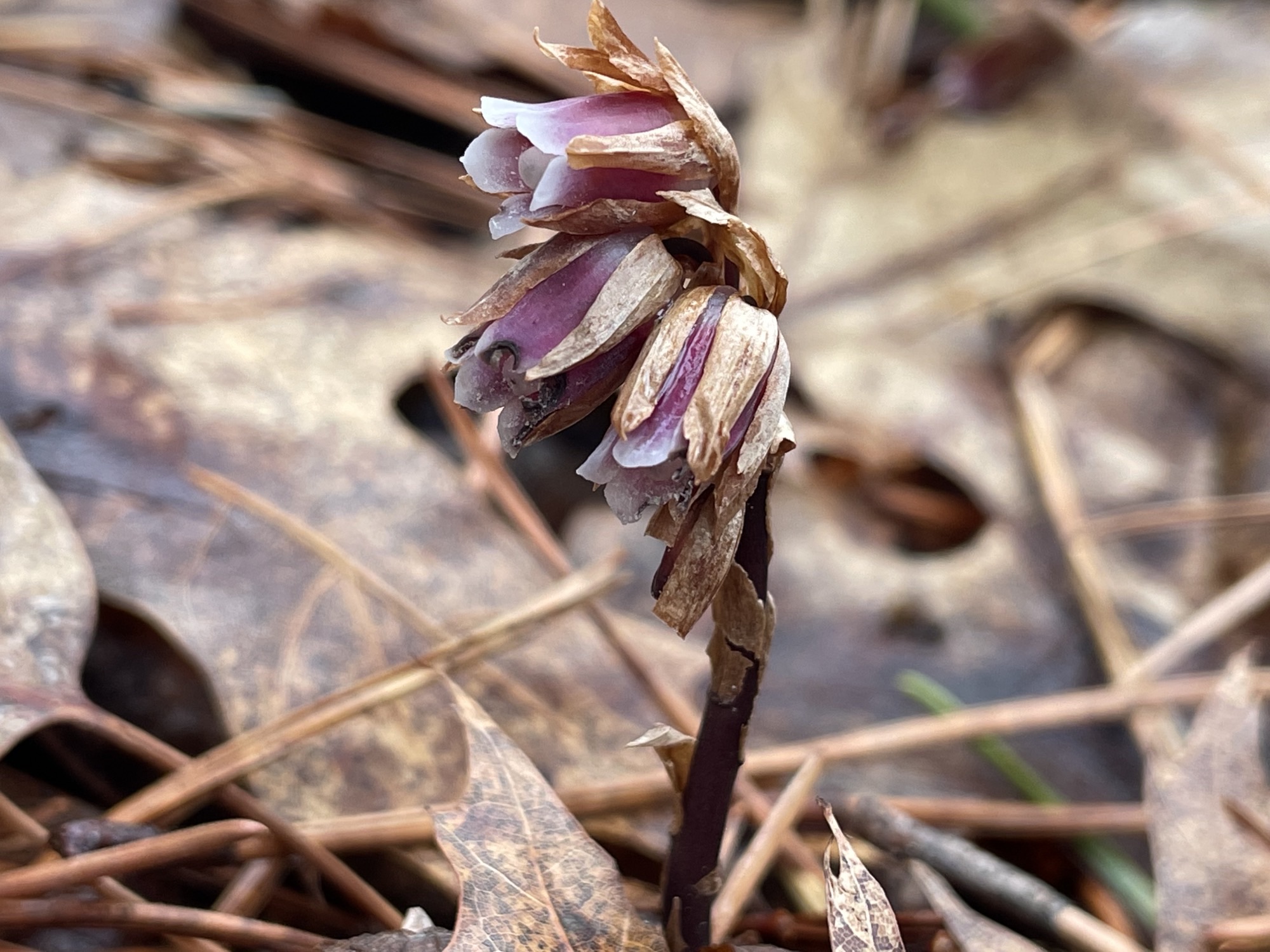
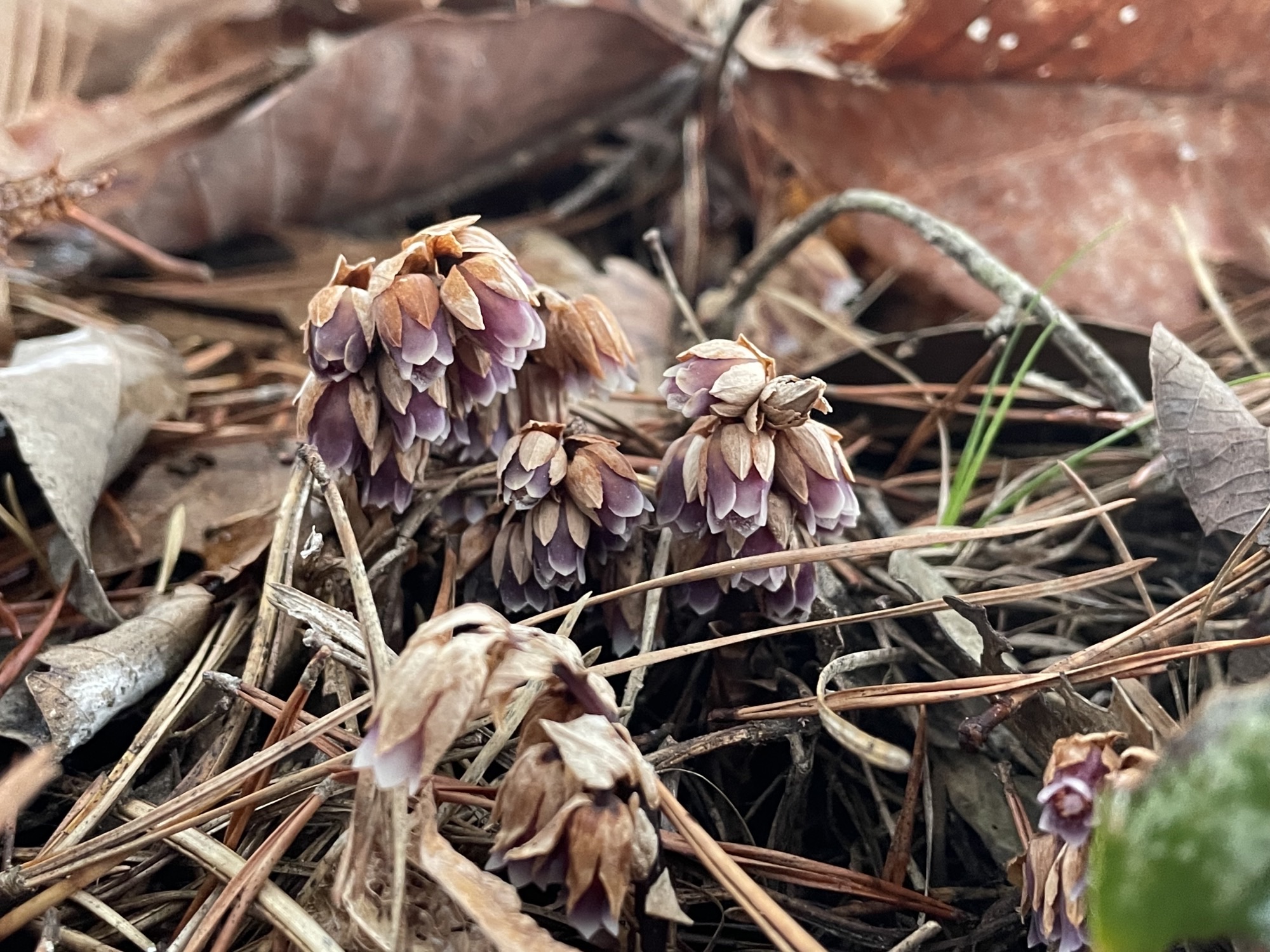
The sweet, sweet pinesap (Monotropsis odorata), a globally rare little herbaceous plant related to the heath family (now placed in the family Monotropaceae, formerly in the Ericaceae), gets its name from the sweet, clove like scent it emits in the early spring. It is one of those plants that you can find just by using your nose. In fact, you would have better luck finding this plant by its smell rather than sight as it’s a master of disguise, camouflaging its tiny self (just a couple inches tall) among the oak and pine leaf litter in the acidic uplands of the Appalachians.
Sweet pinesap. @LittlefieldSweet pinesap. @LittlefieldCan you see the sweet pinesap? @LittlefieldSweet Pinesap global range. This globally rare plant occurs more often in North Carolina and Virginia, but is tracked as rare throughout its range. While state endangered in KY, the Red River Gorge is a disjunct hotspot for sweet pinesap. @BONAP range map.Its leaves are brown and scale like, covering its pale purple flower stalk and yellowish flower, completely disguising the patches of sweet pinesap as oak leaf litter @Littlefield
In addition to its diminutive size, camouflaged adaptations, and strong sweet odor, it is even more of an oddity in the plant world. This little hidden plant gets its energy NOT from the sun, a characteristic plant trait, but from partnering up with mycorrhizal fungi in the soil! No need to photosynthesize and be green if you have friendly fungus among us to help you out. There are not that many plants that have chosen this path of forgoing the sun and going all in with fungal co evolution. These same mycorrhizal fungi are also attached to the roots of the oaks and pines of the acidic Appalachian ridgetop forests and serve an important role of creating an underground network of plants and fungi communicating and sharing nutrients for survival. They call this type of plant a mycoheterotroph-a plant that gets its energy from mycorrhizal fungi.
Pollen from the sweet pinesap falls to the ground. @Littlefield.
One of my favorite springtime rituals in Kentucky is to visit the Red River Gorge at the end of March to early April and use my nose to locate patches of sweet pinesap while hiking along the trails of the upland ridges. During the KNPS wildflower weekend this year, a group of excited plant enthusiasts did just that. Walking the pine oak ridge tops, our group took in the scenes of chestnut oaks, scraggly pitch and Virginia pines, and among the little violets, bluets and tufts of pin cushion and broom moss, a faint sweet smell became stronger, until it was so strong our group stopped and knew we were upon a sweet pinesap population. Looking around the leaf litter, we finally located the sweet pine sap, and we all dropped to the ground to view this little beauty in all is glory, enamored by its wonderful smell and amazing adaptations for survival.
KNPS hike to search for the elusive sweet pinesap. Estella and Henry Berry find the sweet pinesap! @LittlefieldYou have to get down close to view the sweet pinesap. @LittlefieldAlan Abbott gets down close to photograph the elusive beauty. @LittlefieldDr. Koslow, KNPS board member, looks closely at a patch of sweet pinesap. @LittlefieldKNPS hike to search for the elusive sweet pinesap, April 9th, 2022.
Check out this new publication about Trilliums of North America! The report, “The Conservation Status of Trillium in North America,” presents the analysis of 53 plant taxa using two different methodologies. Authors found that habitat loss, overpopulation of white-tailed deer, and habitat disturbance caused by feral pigs are the primary threats to North American Trillium. Every trillium that occurs in North America is included in this publication.
Trillium reaches its peak diversity in the southern Appalachians. BONAP Nodding Trillium (Trillium flexipes). @Littlefield.Great White Trillium (Trillium grandiflorum). @Littlefield.Yellow Trillium (Trillium luteum). @Littlefield.Stinking Benjamin (Trillium erectum). @Littlefield.Authors of the new Trillium publication. IUCN_Natureserve North American Trillium assessment team 2019-2021. KNPS board member Tara Littlefield is one of the coauthors. From L to R: Robert Raguso, Leah Oliver, Anna Walker, Clayton Meridith, Amy Highland, Tara Littlefield, Wes Knapp, Anne Frances, LL Gaddy, Danna Leaman, Aaron Floden, Kjirsten Wayman, Ed Schilling and Alfred Schotz.
Other important links highlighting this publication can be found below:
The Kentucky Native Plant Society recently began formally recognizing individuals by honoring their work with Native Plant Awards in association with the annual Kentucky Botanical Symposium. These individuals are recognized for their outstanding contributions in advancing KNPS’s mission: to promote education, preservation and protection of Kentucky’s Native Plants and Natural communities. The recording from the Kentucky Botanical Symposium awards session is included below.
2021 Native PlantStewardship Award – Jeff Nelson and LizNeihoff
Jeff and Liz among the natural areas in western Kentucky, among the bald cypresses of Metropolis Lake SNP and their woodland restoration.
The recipients of the 2021 Native Plant Stewardship award are Jeff Nelson and Liz Neihoff. Jeff and Liz are most deserving of this award for numerous reasons. First, they both have worked over the past 30 years on an inspiring restoration project in McCracken County, Kentucky, converting their 10 acre property from farmland to native woodland. The stewardship of their property serves as inspiration to the many small scale landowners across Kentucky and the Country. They have documented and shared many of the interesting native plants on social media that have been restored on their property, educating and inspiring thousands of people with their actions and knowledge of our native plants. Their dedication and perseverance in removing invasive species and promoting the return of native plants is notable and reminds us all even the actions of just a few can make an significant impact on restoring our native plants and communities. Beyond their own restoration projects, they serve as preserve monitors at Metropolis Lake SNP, helping out the Office of Kentucky Nature Preserves in rare plant monitoring, invasive species management, and trespassing issues. They are also active in rare plant monitoring and surveying in western Kentucky, documenting rare grassland remnants and rare plants along roadsides in western Kentucky and working with folks to ensure they are protected. Last, their work with the Kentucky Native Plant Society, in particular Jeff’s work as website master, general IT guru, board member, membership chair has been instrumental in the success and advancement of the Kentucky Native Plant Society and its mission.
Where’s Liz? Jeff sometimes shares photos of their restored native woodland with Liz hiding somewhere in the background. We love trying to find Liz, and also enjoy her poetry that often accompanies their native plant posts.
Jeff Nelson was born in San Francisco, CA, and grew up in Sunnyvale, CA. He received a B.S. in Chemistry from the University of California at Santa Barbara. Liz Neihoff was born at home in rural McCracken Co, KY. She received a B.A. in Sociology from San Jose State University in San Jose, CA. Jeff, Liz, and their son Aaron moved from California to McCracken Co., Kentucky, in 1987. After building their house on their 10 acres, the family has spent the last 30+ years restoring the property from farmland to a native woodland. Jeff was employed as the IT Director of the Paducah Independent School District for 15 years, retiring in 2008. Liz was self employed for many years as a gardener and landscape designer and has spent much of the past 30+ years removing exotic invasive species from their 10 acre restoration. They have been members of the Kentucky Native Plant Society since the early 1990s and Jeff has been on the Board of KNPS since 2017. Since 2019, they have shared responsibilities as Nature Preserve Monitors at Metropolis Lake SNP in McCracken Co. As lifelong amateur naturalists, Jeff and Liz love exploring Kentucky and learning about the rich diversity of the Commonwealth’s many ecosystems.
Jeff’s educational posts on social media and the Kentucky Native Plant Societies’ Facebook page, always sharing their knowledge and interesting native plant finds to other native plant enthusiasts in the region.
2021 Native Plant Biodiversity Award – Anne Milligan and Stephen Brown
Anne Milligan and Stephen Brown’s “yarden” in Jefferson county and Anne Milligan displaying their new book “Let the Earth Breath.”
The recipients of the 2021 Native Plant Biodiversity award goes to Anne Milligan and Stephen Brown for their work on converting their backyard “yarden” into a native plant oasis, starting a seed swap movement in the Louisville area, and chronicling their work in a new book and website.
Anne Milligan and Stephen Brown currently reside in semi-rural southeast Jefferson County, Kentucky. Anne is an oil painter and Stephen Brown is an author and historian. Over the past 12 years, they have transformed their yard into a native plant sanctuary and have inspired thousands of folks along the way. Many of you all know of Doug Tallamy’s work promoting native plants and gardening (https://homegrownnationalpark.org/tallamys-hub-1). We in Kentucky are just as proud of the work of Anne and Stephen, they are so inspirational and passionate about using native plants in our yards and serve as a reminder of how the power of just a few individuals can start a movement and inspire others to join them. Due to the tremendous success of their backyard native plant gardens, and realizing the amount of native seed they were producing, they decided to share their love of native seeds by starting Facebook groups and social media campaigns for native seed swaps in Jefferson county. This has been so inspirational to watch this movement grow as they brought together 100s of folks in the region to participate in their native seed swaps gatherings and start native plant restorations projects in their own yards. They have chronicled their work in a new book and non profit organization called Let the Earth Breath http://www.lettheearthbreathe.org/, and we encourage everyone to visit their website, read their book, and join in the native plant gardening and native seed swap movement.
Did you know that the Kentucky Native Plant Society offers small grants to help defer the costs of botanical research, inventory and native plant restoration? Since 2012, KNPS has awarded $8,100 to students working in these areas. Another $750 was awarded in prior years. The total number of grants awarded in any given year is based on the number of proposals received, the quality of proposals and available funding. The graph below shows the kinds of projects that have been funded.
The second type of grant is new and is open to anyone. It will fund
1. native plant inventory, or
2. rare and native plant restoration.
Native plant inventory grants are limited to Kentucky locations and successful applicants will receive a maximum of $250. Rare and native plant restoration grants are awarded to applicants working with native Kentucky plants, preferentially those which are globally rare (G1, G2). Successful applicants will be awarded a maximum of $500. All rare and native plant restoration grants require coordination with the Office of Kentucky Nature Preserves (OKNP) and the Kentucky Native Plant Conservation Alliance coordinators prior to application.
A grant proposal must include:
A current curriculum vitae;
A proposal (not to exceed two single-spaced typed pages) describing the proposed research and the role the grant would play in the research;
An itemized budget;
A letter of recommendation from the applicant’s major professor or project director; and
Indicate whether the grant request is for a student research grant, a native plant inventory grant or a rare and native plant restoration grant.
If the grant is for rare and native plant restoration, include a letter of support from OKNP.
Budget items typically funded include travel to research sites and supplies such as herbarium paper and lab consumables. No personnel time will be funded.
All Grant Proposals are due by April 1st, 2022.
If you are interested in applying for any of the KNPS grants, visit the Grants page at the KNPS website. If, after reading the grants page, you have any questions, please email them to: grants@knps.org
As we send out our last newsletter of the year, I wanted to give thanks to all our membership for supporting Kentucky Native Plant Society over the years and to all of the new members who continue to give me hope for our growing organization. We have been able to accomplish a lot this year as an organization, from organizing several virtual meetings, hosting a few in person hikes as well as contributing to native plant documentation through our inaturalist projects and plant atlas and distribution efforts. Our grants program continues to fund important native plant research conducted by students at universities and has expanded to include rare plant restoration efforts. The ladyslipper continues to be a monthly resource to find the latest native plant news and our website is continually improving as we provide compile native plant resources such as native plant sales, nurseries, herbariums and general native plant information . Our last organized event of the year, the annual Kentucky Botanical Symposium, is next Wednesday, December 8th, 9am-11:30am EST, and I encourage everyone to join in and learn about some current native plant projects programs occurring across our state and also learn from nearby state partners on existing programs that we could network or model here in Kentucky. I hope that everyone has had time to see the beautiful fall colors and the first glimpse of the frost flowers here in Kentucky, I know my family has enjoyed the first frost flower finds! Please check our website for any updates, upcoming planned events, visit our gear shop for gifts for friends and family, and visit a nearby natural area to view all of our wonderful native plants as they transition into winter. One of my favorite winter native plant activities is moss and lichen hunting, native plant wreath making, and reviewing the bud and bark characters of our many native trees.
Have a great December and upcoming Holiday fellow native plant enthusiasts!
For the love of Kentucky Plants,
Tara Rose Littlefield
Littlefield Berry Family Enjoying the first frost flowers (from wingstem, Verbesena occidentalis) of the year in Anderson County, Kentucky,2021-11-06.
Xerohydric Prairie remnant, Russell County, Kentucky, Eastern Highland Rim. @T. Littlefield
Wednesday, December 8, 9AM-1130AM EST, virtual and free
“Coming Together to Discuss Current Botany Projects: Conservation and Collaboration in Kentucky and Beyond”
Kentucky Native Plant Society (KNPS) is hosting our annual botanical symposium on Wednesday, December 8th from 9AM-1130AM EST. For several years, KNPS has organized a botanical symposium in the fall/winter with a goal of bringing together professionals, community scientists, academics, researchers, gardeners and students in order to learn about what’s going on in the world of Kentucky Botany and beyond. Please join us!
To Kentucky Native Plant Society members and general native plant stakeholders! While the symposium agenda will highlight updates from Kentucky native plant society, the office of Kentucky Nature Preserves, and our main speakers from division of water, NRCS/Quail Forever/Southeastern Grasslands Initiative, and the Illinois plants of concern program, there will also be a section devoted to hearing about native plants projects from KNPS members and native plant stakeholders like YOU! If you would like to be included in this section, please send an email to Tara Littlefield @ tara.littlefield@ky.gov about the native plant project you are working on and you will be added to our stakeholder announcements section.
We are very excited to announce the agenda, featuring updates from botanists/ecologists from the Office of Kentucky Nature Preserves on state listings, adding plants to the state wildlife action plan, adopting a rockhouse in the RRG, implemented plant conservation conservation horticulture projects, and current monitoring programs; updates from Kentucky Native Plant Society board members on upcoming meetings and projects; Chris Benda, the Illinois botanizer, will be talking about the rare plant monitoring program he leads in southern Illinois, Brittney Viers will discuss working with private landowners to restore remnant prairies, Joey Shaw will discuss the Tennessee-Kentucky Plant Atlas, and Brittany White will provide updates on the Wetland Assessments conducted by Kentucky Division of Water. Click on the PDF below for the agenda.
Kentucky Botanical Symposium 2021 Speakers and Facilitators :
Brittney Viers, QF/NRCS TN State Coordinator/Southeastern Grasslands Initiative Liaison will be discussing Remnant Grassland Restoration on Private Lands in Kentucky and Tennessee.
“I’m originally from Northeast TX, which historically was the Blackland Prairie region. My parents and I moved to southern Indiana since my Mother is from there. I spent the rest of my childhood growing up on a row crop and cattle farm, but realized that natural history and ecology was my passion. While in college at Murray State University studying Wildlife Biology I started working for IN DNR Div. of Nature Preserves and fell in love with the glades and barrens of southcentral IN. I stayed at MSU to acquire a masters degree in Botany. Because of my native plant and natural communities knowledge, I became a quail biologist in KY and later in TN working with private landowners desiring to restore habitat and improve their quail and other upland wildlife populations. In 2019, I got the chance to have a strictly grasslands and quail focused position through a specialized Farm Bill grant in both KY and TN. I will always strive to merge private lands work with restoration practices in degraded remnant grasslands since they are in desperate need of our recognition, care, and attention”.
Brittney Viers, QF/NRCS TN State Coordinator/Southeastern Grasslands Initiative Liaison, in a grassland remnant.
Chris Benda, Botanist and former president of the Illinois Native Plant Society will be discussing Monitoring Rare Plants of Southern Illinois (Plants of Concern program).
Chris Benda is a botanist and past president of the Illinois Native Plant Society (2015-2016). Currently, he works as a Researcher at Southern Illinois University, where he coordinates the Plants of Concern Southern Illinois Program and teaches The Flora of Southern Illinois. Besides working at SIU, he conducts botanical fieldwork around the world, teaches a variety of classes at The Morton Arboretum and leads nature tours for Camp Ondessonk. He has research appointments with the University of Illinois and Argonne National Laboratory, and is an accomplished photographer and author of several publications about natural areas in Illinois. He is also known as Illinois Botanizer and can be reached by email at botanizer@gmail.com. Visit his website at https://illinoisbotanizer.com/
Chris Benda in a native grassland showing off a rare orchid in Illinois.
Brittany White, Division of Water Wetland Biologist, will be discussing Wetland Monitoring in Kentucky.
Brittany is a wetland biologist with the Kentucky Division of Water’s Wetlands Program. After spending several years working in wetlands across the southeast, she is happy to work in Kentucky searching for salamanders, admiring soil profiles, and of course, looking at plants. Although not in her job description, she also specializes in performing terrible nature-based parodies for her coworkers. When Brit is not at work, she enjoys meandering the woods with her best mutt Evelyn, hanging out with her two kiddos, and having far too many hobbies than is reasonable.
Brittany White, Division of Water Wetland Biologist
Dr. Joey Shaw, Associate Professor @ University of Tennessee, will be presenting on the Kentucky Tennessee Plant Atlas Project.
Tara Littlefield, Botanist and Plant Conservation Section Manager at the Office of Kentucky Nature Preserves and President of the Kentucky Native Plant Society, will be co-facilitating the meeting and presenting updates on on a few priority plant projects from OKNP.
Tara Littlefield is the senior botanist and manager of the Plant Conservation Section at the Office of Kentucky Nature Preserves. She serves on the board of the Kentucky Native Plant Society and coordinates the state’s plant conservation alliance activities-a public private partnership working on rare plant and community conservation. She grew up on the southern edge of the cedar creek glade complex in Hardin County, Kentucky and has had a fascination with the natural world since a small child. Tara has a B.S. in Biochemistry from University of Louisville and a M.S. in Forestry/Plant Ecology from the University of Kentucky. Much of her work involves rare species surveys, general floristic inventories, natural areas inventory, acquisition of natural areas, and rare plant/community restoration and recovery.
Tara Littlefield in her happy place along the river scour in the Big South Fork.
Vanessa Voelker, botanist at OKNP, will be discussing the adopt a rockshelter program and other volunteer opportunies.
Vanessa Voelker is a botanist with the Plant Conservation Section at the Office of Kentucky Nature Preserves. Originally from central Illinois, Vanessa worked as a lab tech for the USDA before fleeing the lab for the woods, and honed her skills as a botany technician in Missouri and Indiana before coming to Kentucky in 2020. When she isn’t in the field, Vanessa is active on iNaturalist (@vvoelker) and is always happy to help with plant identification and offer pro-tips for differentiating between tricky species
Vanessa finding a heart shaped leaf in limestone barrens.
Kendall McDonald, OKNP botanist/lichenologist will be presenting on the forest biodiversity project and lichen assessments.
Kendall McDonald is a KY native who researched lichens at Morehead State University. Since 2017, she has been a botanist and lichenologist with the Office of Kentucky Nature Preserves. She is the lead on OKNP’s Forest Biodiversity Assessment Program and lichen monitoring
Kendall excited to find lungwort lichen, an old growth forest indicator.
Rachel Cook will be discussing the Kentucky Native Plant Suppliers database. Rachel Cook is a botany technician with the Office of Kentucky Nature Preserves. Rachel is a Kentucky native, growing up on a farm in Perryville, Kentucky. She graduated from the University of Kentucky with a B.A. and a B.S. in Environmental Sciences, but botany was always her passion. As a botany technician, she helps on rare plant surveys and floristic inventories throughout the state. When not working, Rachel is tending to her house plant collection, hiking around Kentucky, or cuddling her cat.
Rachel and the state endangered small white ladyslipper.
Heidi Braunreiter will be presenting the KNPS updates and upcoming events. Heidi is a botanist and burn boss for the Office of Kentucky Nature Preserves. She is originally from Wisconsin and has done botanical surveys across the eastern United States. Heidi received her B.S. in Biological Aspects of Conservation and a certificate in Environmental Studies from the University of Wisconsin-Madison. In 2011, she met Dr. Ronald Jones on a KNPS Wildflower Weekend hike and decided to pursue a graduate degree at Eastern Kentucky University. She received her M.S. in Biology at EKU and finished her master’s thesis on A Vascular Flora of Boyle County, Kentucky.
Tony Romano will be providing an update to the states roadside pollinator habitat project. Tony is a botanist with the Plant Conservation Section at the Office of Kentucky Nature Preserves. He is the project coordinator for OKNP’s roadside pollinator habitat project. Originally from Illinois, Tony received a M.S. in Geography from Southern Illinois University. Tony spent several years working in land management and botany in Colorado before moving to Kentucky in 2019. When not botanizing he can be found climbing in the red river gorge and fly fishing on Elkhorn Creek.